
Encourage Plant Sex for Beer’s Future
A University of Minnesota researcher, is dedicating time to Humulus lupulus breeding and we need to, as brewers and beer lovers, to support causes like his. Hop breeding is a tricky thing for someone to pick up. We’ll get into the intricacies that make it difficult later. Before addressing the breeding process here is a brief overview of hops;
What are hops?
“Hops” are a female flower, or seed cone, of the Humulus lupulus plant. These plants, unless under certain circumstances, have one sex. They are either male or female plants. Most growers will cull the males to prevent their pollen from seeding the female cones.
Why prevent seeding?
The 3 main reasons for this is there are some changes that occur that increase fats that may impart off-flavors, seeded hops weigh more, (we buy hops by weight) and hops are typically processed into pellet form. I’ll point out reasons why we need to overlook these things and begin using males again. I’m going to try to convince you to invest in at least one male or encourage whomever you get the hops from to adopt/support a breeding program. Here’s why;
Size matters
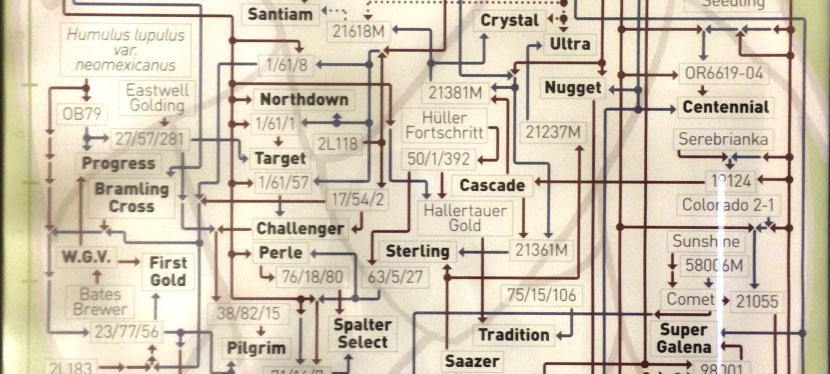
If you look at the chart you will notice several dead end hop linages. Let’s look at crystal for example. Notice that crystal has no offspring? If you look up a description of crystal, it says the word “Triploid.” This means that males produce very little seeds. This is caused by a chromosomal imbalance. It is suspected that female hop cones in the presence of these males lead to larger cones. That’s good news for us all.
Hops are Proprietary
Take a look at citra hops. This cultivar has been around since 1990. It was a result from breeding a brother and a sister together with a Hallertauer Mittelfrüh mother. Yeah, breeding involves a lot of incest, but that’s how it works. After several breedings you have a hop with a completely unique and very desirable characteristic. Due to the proprietary nature we are unable to get a true citra cultivar. I imagine it is an aneuploidy cultivar. You can breed a desired cultivar in such a way it can’t reproduce. We should be breeding to prevent being held by the pockets of the few that are hop breeding.
Seeded Hops can Still be Brewed With
I have previously posted about how to remove haze during the boil. Seeded hop fats can be removed with hot break. I’d stay away from the whirlpool and dry hop with seeded hops.
Better the supply/Better the IPA
Breeding for selective qualities allow us to have bigger and better hops. I think we all could go for another designer hop.
Back to Breeding
When you breed hops you will need a male and a female. Sound familiar? When you buy rhizomes on the internet it is likely going to be female or, in rare cases, exhibit both sex. Here’s the tricky part: No males. No where. Why would you buy a male? They don’t produce cones, they will seed your females, and they take up resources you could use to have another female. Even if you did want to buy a male, you’d be shooting for the 50/50 chance of a seed becoming male. Solution: You can find males in the wild and/or work with researchers that have males. (They typically don’t want the males anyway) I know it may sound crazy to go searching for hops in the wild, but in Minnesota I’ve found several wild hops. You just need to be looking for them. Another tricky (or sticky) situation: Hops are pollenated by wind. This means that the cones need to be isolated and pollenated by the desired male pollen artificially or that is the only male within miles. One last example problem is that it takes raising several plants of a suspected positive trait to test its impact on the beer it’s in. This means the researcher must be adamant about the greatness of the offspring’s traits to invest in a small farms-worth of that offspring. It typically takes several generations of breeding siblings with parents to get the desired traits.
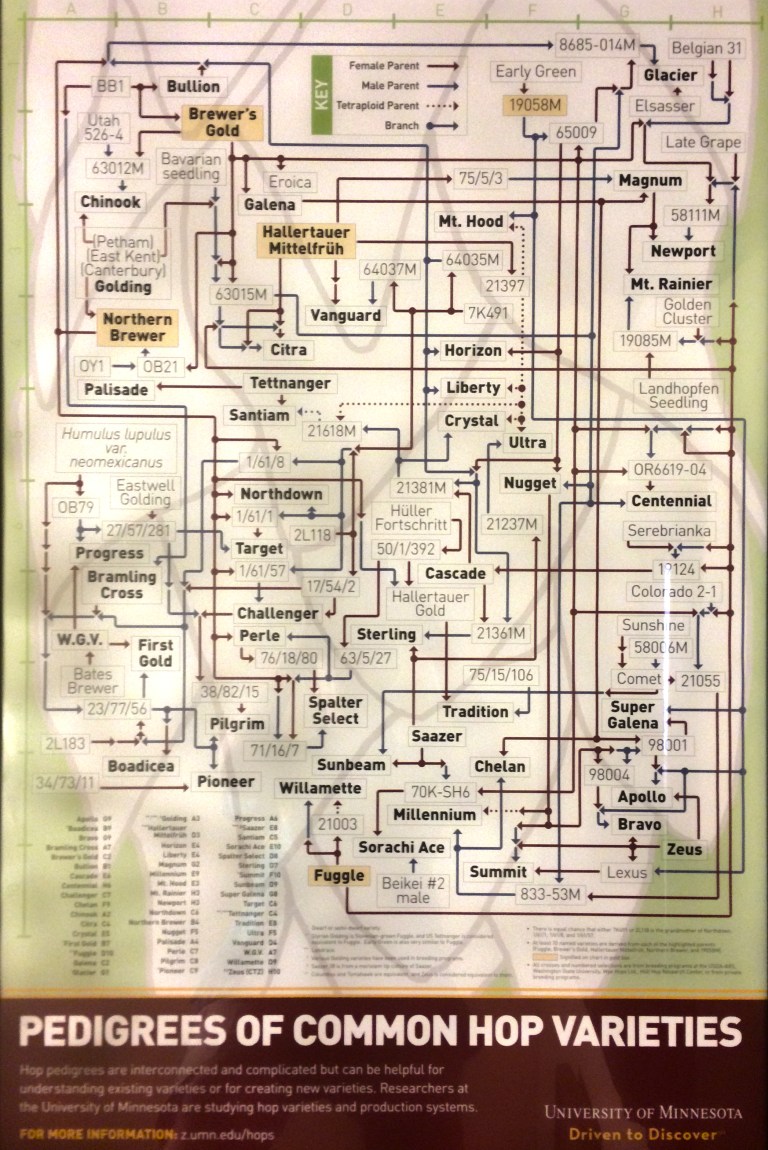
Back to the Pedigree (in the making)
hop-pedigree-umn <-link to PDF page
This chart is awesome. The researcher is one of the coolest beer allies I’ve met. We need people like him if we want a greater quality and quantity of hops. We need to know what the brewers want. I don’t mean a specific flavor, while that would be cool, but a likes and dislikes about hop characteristics would be helpful. Right now, most breeding is done based off of disease resistance and cone size. The breeding performed to get the cultivars that we enjoy is a complex web of incest and sterility, but hey, It’s what it takes for a world of ever-improving beer.
 Zymologist.com