Summers are for Sours

The (Not So) Basic guide to Sours

This summer is HOT! I’ve seen videos of car hoods cooking bacon, I’ve felt myself drown in brewery sweat, and the whole thought of summer has me feeling sour. Good news about the 110 degree weather we’ve been having; It’s the ideal temperature for making sour beers.


What makes beer sour?


Sour beer is beer that has been made acidic. It often tastes tart and, if crafted correctly, dynamic in flavor. It can be organically created by microorganisms or added artificially.


What is the difference between adding Acid to beer and Souring beer/wort?


Have you ever compared artificial flavoring and the real deal? It is very similar. Artificial acids, like citric acid, leave a sour flavor without a level of complexities behind it. We’ll get into Sour Beer Complexities later. Biologically generated wort is like creating several colonies of unique organisms to generate a masterpiece of left over… without getting too in depth and driving you away; It is much like Beer compared to ethanol and malt extract. There is a lot more to it than meets the eye.


Microorganisms that can make and break beer

Saccharomyces

We’ll start with yeast but we’ll be brief since it is key player in beer fermentation. They can contribute esters if treated appropriate and can come in many different varieties that lead to several flavor compounds relating from bananas to peach or butterscotch to vomit if you don’t know what you are doing. This isn’t the key player for this topic, however, very important.

Lactobacillus

Some brewers fear this guy. Other brewers learn how to harness its power and show it it’s place. This microbe is the sour milk bacteria. Yogurt, pickles, and sour dough are all by-products of lacto. It may be, other than Saccharomyces, my favorite microbe. It spits up lactic acid that contributes to the unique food’s flavor. It is relatively easy to kill and provided you have good sanitation practices it won’t be staying around unless you want it to. It also grows well at 110 (degrees) Fahrenheit but can’t withstand a good boil.

Pediococcus

It’s in the lactobacillaceae tree so it’s pretty similar to lacto. It produces lactic acid and aids in sauerkraut fermentation. It’s a big risk with diacetyl. It is also pretty dang easy to kill so no contamination worries about this one either.

Brettanomyces

If making sour beer was an Olympic relay I imagine this guy is the anchor and takes the gold each time. It gives off a barn yard flavor and aroma. It is also described as horse blanket. This guy is so tough it can eat wood sugars. (Hint: barrel aging with this guy is awesome) It is also near impossible to get rid of once you have brewed with Brett. I suggest using separate dedicated equipment when dealing with this one. I imagine after a great mass extinction, like a nuclear winter, it will be twinkies, cockroaches, and Brettanomyces hanging out until the end of time. Some strains have the mechanism to make acetic acid. We really don’t want our sour to turn vinegar.  The resilience of this organism is what really allows the sour beers to be made prior to fermentation. The pH is too low (it is super acidic) for some yeasts to really perform the way they normally would.


The above team add intermediate compounds of fermentation, and lactic acid. Those intermediate compounds give it the complexities that beat the just-adding-acid approach.


Ways to Sour


You can sour at any point in the brewing process; Mash, kettle, fermentation, and storage. I don’t really like souring beer I’ve already made so I don’t practice souring during fermentation and storage. You can get great results souring at those steps but my logic is this; “if I made beer that is good why would I make it go sour?” This means I sour before it is beer.

If you do a sour mash don’t sour the entire mash, save about 5% of your grist for souring then add the sour grains to the mash. Kettle souring is what I prefer. I actually use a fermentor for my kettle sour but I do it after the mash and before the boil so it’s a “kettle sour.” I go the natural root for souring and just add some non-mashed grist as my “pitch” but you can buy all sorts of microbes online. My method doesn’t always yield the same like a controlled pitch does, but hey, character. If you want a reproducible sour: buy and grow the microbes. Don’t forget to wait for your temp to drop to 110 before pitching. For all methods of souring it is pretty much the same;


1.     Get the pH of Your Wort/Mash Below 4.5

Add food grade lactic acid or whatever it takes because you want to inhibit the growth of organisms that don’t sour. If you don’t get your pH down, you could end up growing a soup of botulism or anthrax and that would suck.

2.     Make the Environment Anaerobic

Attach or get your CO2 (if you don’t keg beer yet and still bottle, get yourself kegs and CO2) at the bottom of your souring vessel and pump CO2 as long as you can tolerate. Overnight works if you want to keep the CO2 flow low and long or if that doesn’t work you can do higher flow for more than 10 minutes. CO2 is heavier than oxygen (O2) and will push it up and out of your vessel. Doing this scrubs out oxygen and acidifies your soon-to-be sour mixture. The scrubbing (removal) of oxygen is crucial! With oxygen other organisms grow, the organisms that you want to grow are not going to produce acidifying products, and it typically turns out putrid. Make sure to cover your vessel so oxygen does not fall back into your vessel.

3.     Find a Sanitary Way to Check the pH

I soak a long pipette in sanitizer to pull my samples. Monitoring pH is brewing may be more important than gravities. It is SOOO IMPORTANT. pH is the omnipresent and omniscient aspect of any aqueous solution. It is what well tell you if you are souring or not. I try to end before it gets to a pH of 3.3. After about 3.4 it gets too sour for yeast to ferment it. “Hello, is it me you’re looking for?” –Brett. It’s also crazy sour below 3.3.

4.     Keep it Warm!

Around 110 degrees Fahrenheit for souring or as close to that as you can get it. That was the whole point of this article. Hopefully summer has got you thinking sour too.
Hop Pedigree

Encourage Plant Sex for Beer’s Future

A University of Minnesota researcher, is dedicating time to Humulus lupulus breeding and we need to, as brewers and beer lovers, to support causes like his. Hop breeding is a tricky thing for someone to pick up. We’ll get into the intricacies that make it difficult later. Before addressing the breeding process here is a brief overview of hops;


What are hops?


“Hops” are a female flower, or seed cone, of the Humulus lupulus plant. These plants, unless under certain circumstances, have one sex. They are either male or female plants. Most growers will cull the males to prevent their pollen from seeding the female cones.


Why prevent seeding?


The 3 main reasons for this is there are some changes that occur that increase fats that may impart off-flavors, seeded hops weigh more, (we buy hops by weight) and hops are typically processed into pellet form. I’ll point out reasons why we need to overlook these things and begin using males again.  I’m going to try to convince you to invest in at least one male or encourage whomever you get the hops from to adopt/support a breeding program. Here’s why;


Size matters

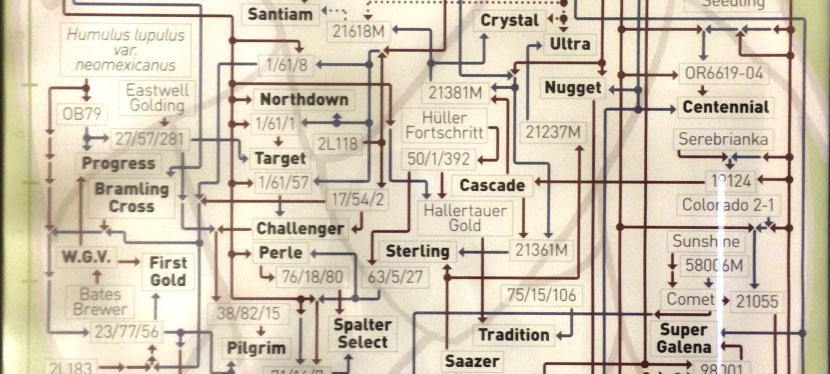
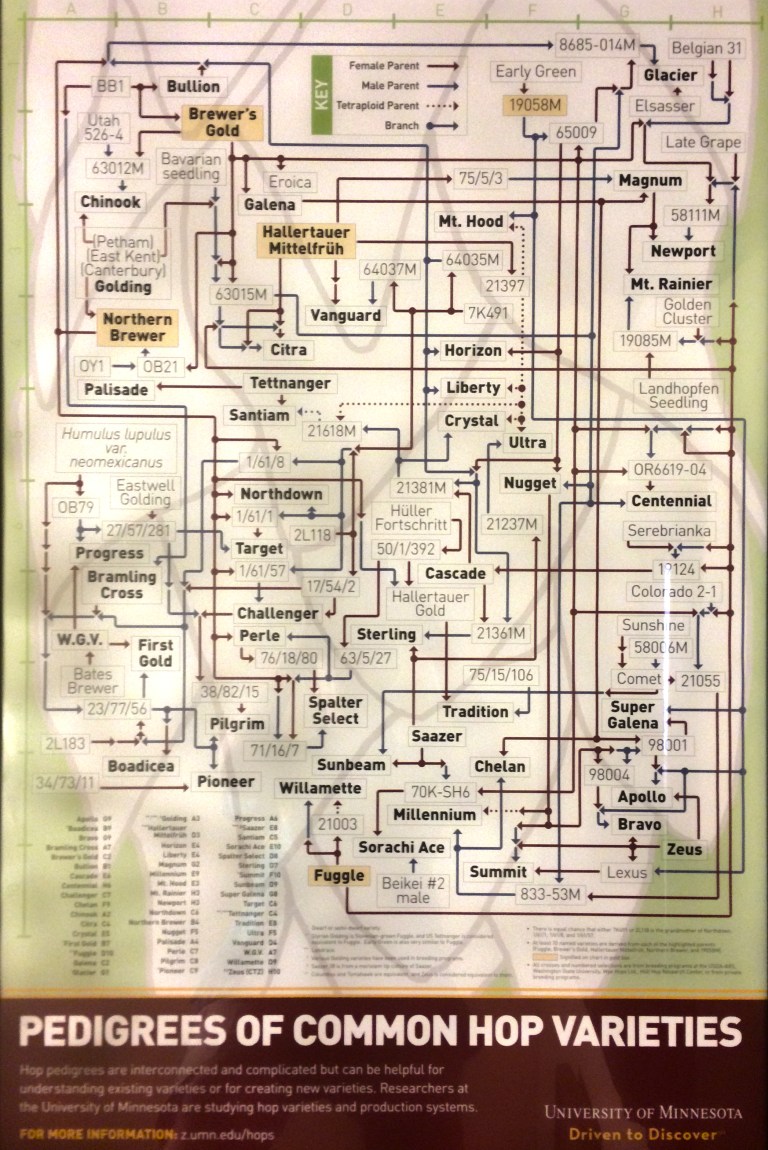
If you look at the chart you will notice several dead end hop linages. Let’s look at crystal for example. Notice that crystal has no offspring? If you look up a description of crystal, it says the word “Triploid.” This means that males produce very little seeds.  This is caused by a chromosomal imbalance. It is suspected that female hop cones in the presence of these males lead to larger cones. That’s good news for us all.

  1. https://dl.sciencesocieties.org/publications/cs/abstracts/19/1/CS0190010027?access=0&view=pdf

Hops are Proprietary

Take a look at citra hops. This cultivar has been around since 1990. It was a result from breeding a brother and a sister together with a Hallertauer Mittelfrüh mother. Yeah, breeding involves a lot of incest, but that’s how it works. After several breedings you have a hop with a completely unique and very desirable characteristic. Due to the proprietary nature we are unable to get a true citra cultivar. I imagine it is an aneuploidy cultivar. You can breed a desired cultivar in such a way it can’t reproduce. We should be breeding to prevent being held by the pockets of the few that are hop breeding.

Seeded Hops can Still be Brewed With

I have previously posted about how to remove haze during the boil. Seeded hop fats can be removed with hot break. I’d stay away from the whirlpool and dry hop with seeded hops.

Better the supply/Better the IPA

Breeding for selective qualities allow us to have bigger and better hops. I think we all could go for another designer hop.


Back to Breeding

When you breed hops you will need a male and a female. Sound familiar? When you buy rhizomes on the internet it is likely going to be female or, in rare cases, exhibit both sex. Here’s the tricky part: No males. No where. Why would you buy a male? They don’t produce cones, they will seed your females, and they take up resources you could use to have another female. Even if you did want to buy a male, you’d be shooting for the 50/50 chance of a seed becoming male. Solution: You can find males in the wild and/or work with researchers that have males. (They typically don’t want the males anyway) I know it may sound crazy to go searching for hops in the wild, but in Minnesota I’ve found several wild hops. You just need to be looking for them. Another tricky (or sticky) situation: Hops are pollenated by wind. This means that the cones need to be isolated and pollenated by the desired male pollen artificially or that is the only male within miles. One last example problem is that it takes raising several plants of a suspected positive trait to test its impact on the beer it’s in. This means the researcher must be adamant about the greatness of the offspring’s traits to invest in a small farms-worth of that offspring. It typically takes several generations of breeding siblings with parents to get the desired traits.

hop-pedigree-umn
You can buy a copy of this from the university. 

Back to the Pedigree (in the making)

hop-pedigree-umn <-link to PDF page

This chart is awesome. The researcher is one of the coolest beer allies I’ve met. We need people like him if we want a greater quality and quantity of hops. We need to know what the brewers want. I don’t mean a specific flavor, while that would be cool, but a likes and dislikes about hop characteristics would be helpful. Right now, most breeding is done based off of disease resistance and cone size. The breeding performed to get the cultivars that we enjoy is a complex web of incest and sterility, but hey, It’s what it takes for a world of ever-improving beer.


Haze Removal Two (Cold Break)

Is your homebrew cloudy? Do you like beer with clarity? Do you find yourself with cloudy beer even after the yeast has flocculated? It’s okay that your beer has haze to it. It just means it contains more protein than the visually translucent brew. Okay okay okay. We’ve heard this before. Maybe we followed the carrageenan talk (enter hyperlink) and our beer still has some haze to it. The carrageenan approach only really works on hot break. Hot what? Hot break. It’s the fats, proteins, and lipids that coagulate as a sticky gross mess on the bottom of the boil kettle. It becomes more apparent when you whirlpool. (we’ll get into that on another post) This post isn’t for hot break. This post is for cold break.

What is cold break?

Cold break is precipitation of proteins, tannins, and hop debris. It occurs around below 130 degrees Fahrenheit and is most effective when quickly cooled below that.

How to quickly cool wort?

There are many ways to cool wort. There are arguments that it is best to cool in the kettle so that you do not pump the cold break into the fermentor. If that’s your thing, cool. I personally like using an inline heat exchanger but I have access to a cold liquor tank and small pumps. I do pump the wort with cold break into the fermentor, but I either dump the cold break or rack the beer off of it when it settles. A copper coil with a cold hose water flowing through it can do the job good enough. If you have that and a whirlpool you are in great shape! (we’ll get to the whirlpool later, okay?)

Break is not all bad, yeast need protein too. Some compounds in hot and cold break can serve as a yeast nutrient. Proteins are key to a good head on beer too, so don’t over do it! Some styles of beer are supposed to have haze so just adjust your haze removal regime to tailor it to the style you are brewing and you’ll be well on your way to better, world class beers.

If you have any other tips, feel I missed something, or disagree leave me a comment here or on Facebook!

The Early Brews

Wednesday, January 22nd 2014

I attended college at Minnesota State University, Mankato. In microbiology classes we learned about making beer but never in enough detail or in practice. During this time I lived with several international students. I had mentioned the idea of making beer to a few of them. The German international student laughed and said, “Why would you make bier!? Go to the store for bier.” My friend and roommate from Nepal stated, “I Like beer. Beer is good. Do it.” One of my closest friends, the Australian, said, “Hell yeah, dude. Let’s make beer. None of that weak stuff though.”  Those of you who knew us at the time would know that there was a lot more profanity in that statement. So we began making beer. We decided that a kit would be a good place to start and we picked a beer that we wished we could buy, a saison. It turned out wonderful! We drank it all the weekend it was ready, became elated, and knew that if there was beer like this commercially available it would out sell the large pilsner companies. (You know who) Looking back on this it’s funny because they seem to be commercially available everywhere. We discovered that craft beer was going to be the next big thing right as the boom began. We had a roommate that felt, “uncomfortable” about us making beer, as if it was illegal. (what a loser) I cared so much about making beer we paid him a few months rent and told him to get lost. My Aussie friend and I used to, and continue to do so, talk about starting a brewery called ‘Bushfire Brewing Company’


beer-blog-buds
That’s my Australian friend (right)and me (left) joking on snapchat between home brews. We made Fail Friday sections of social media more often than not. We are infamy.

Tips for Buying Craft Beer

I recently read an article about beer not spoiling. I won’t die or become poisoned (excluding ethanol) by beer. NO MATTER HOW OLD!? Cool. But we’ve all done it. We’ve all bought beer. We have tasted victory and consumed dread. Craft beer. I see some reviews on untapped whilst consuming something that I would call acceptable, for the style of beer, and read a scathing remark about it. (pick your off flavor. I pick “meaty”) I have no doubt that they are tasting something, meaty, that is associated with yeast death. Before passing judgment look at your beer buying and storage strategy. If you’re just looking to get better beer buying results or to impress your friends with a well purchased six-pack, look no further;

#1 Is the beer stored cold?

This is easy to pick out at the liquor store. This one is the most important. The best liquor stores I visited HAVE their craft beer refrigerated. Beer is consistently approaching an equilibrium. The chemicals inside of your beer is slowly changing from the day it’s bottled.  Keeping it cold helps slow the aging affects on the beer and it is ready for immediate drinking.

#2 How old is the beer?

Beer experts will all agree that fresh beer is the best. We like beer so much we consume it before its packaged. Typically, distributors claim that the beer is good for a year. Maybe the craft brewery agrees. Maybe they don’t. This can be really easy to determine if they have a “packaged on” date. Other breweries use a “Best by” date on the package. “Best by” dates make it hard to confirm how fresh the beer is. The breweries should know better than to date something that will be oxidized before date, but profits and distributor/retailer demand plays a heavy role. Check the bottom of the bottles, is there a large amount of sediment? Unfiltered beers will have sediment, but still can’t hurt to make sure you don’t have a centimeter of growth on the bottom. That much growth is probably not a good sign. Is there dust on the packaging? I know this one seems obvious, but it’s easy to let snazzy marketing predator feline distract you from the cougar-aged beer. I recently had a beer that tasted like potpourri. I’ve had that limited release beer before at their brewery. When it was fresh it had a wonderful melody of guava, malt, and passion fruit flavors. After a year, I purchased it at a liquor store, it tasted like something your grandmother fills the vase on her toilet with.

#3 Is there direct light in contact with the Beer?

Some larger breweries can monitor and predict the exact moment of staling agents. (Notice I said predict, not prevent.) Some breweries are now taking to using pre-isomerized hops to have their beer change less over time. Import beers taste, light struck or like cardboard/trans-2-nonenal) Most craft breweries don’t choose to use hop-oils or end product additions. This means that if there is a window shining light directly on the bottles, you guessed it, its going to be different. This one is only applicable to bottles.

#4 How far did the beer travel?

If you are uncertain on what to pick; Pick local. LOCAL. That is craft beer.

Conclusion

Most of the tips will likely push you into being more of a can consumer. Cans are more eco friendly and are less prone to flavor changing environmental factors. If you have any other tips, feel I missed something, or disagree send me a message or comment here or on facebook!

bad-beer
Look at the dust on the bottle! It did have a package date. This one is 10 months old. 

Introduction to Zymology

Friday, June 3rd 2011

It was 5 days away from my 21st birthday. My brother, his friends, and myself went on a trip to celebrate the life of my brother’s father. He is actually my half brother by blood, but he is 100% my brother. His dad, like my brother, is very intelligent with a photographic memory. To put this in perspective, my brother, is a well respected neurosurgeon. On our way to a small bar, one that my brother’s dad frequented, we toured Ireland. It was my first time traveling abroad. It was also my first time ever legally indulging in fermented beverages. I had no idea that the events on this trip would have profoundly impacted the direction of my career. We visited Old Bushmills Distillery and the Guinness Brewery. The brewery tour is the most prominent early life beer-memory I have. The tour lacked personal flare, now something I always add when giving a tour, but had a vast amount of information beautifully presented on screens. Before this moment I never thought about the complexities, the science, and the joy that is involved in fermentation science. Thanks bro!

zymology-memory
My brother (right) and myself (left) at the Guinness water exhibit.

!

Remove Haze (The Carageenan Talk)

Is your homebrew cloudy? Do you like beer with clarity? Do you find yourself with cloudy beer even after the yeast has flocculated? It’s okay that your beer has haze to it. It just means it contains more protein than the visually translucent brew. Why do you have more protein!? It is not because you are trying to yolk to shredded status. (No matter how much we kid ourselves.) It might be because you are new to all-grain or it might be because you are unaware of carrageenans. Carra-what? Carrageenans. It’s sulphated polysaccharides in such a structure that it coagulates proteins. Poly-huh? Coagula-who? Let’s make this really simple;

Carrageenans are a sugar that is extracted from a seaweed commonly called ‘irish Moss’ even though it is mainly exported from China and the Philippines. This sugar has such a structure that it binds to proteins. The type that brewers use, Kappa, forms gels with proteins in the presence of potassium. This is largely useful because chill haze is a protein and wort has potassium ions! It’s considered food safe and comes in several forms. When given the choice of using Irish moss or processed kappa-carrageenans I go with the processed type. I figure if I’m going to add something to my beer it should be the substance I intend to use. (You don’t put the entire barley stem in with the mash.) I add it 5 minutes before the end of boil. (That means at the 55 for you 60-minute boil folk.) Most companies say 1 tablet for 5 gallons but I find I can get away with breaking up the tablet and using it on 3 to 4 different brews. I can find tablets for $0.25. So… 5 cents for clear beer? Sounds worth it to me. If you have any other tips, feel I missed something, or disagree leave me a comment here or on Facebook!

Useful Sites:

  1. https://www.homebrewersassociation.org/how-to-brew/beer-haze-cloudy-homebrew/
  2. https://www.morebeer.com/products/kick-carrageenan-tablet-1.html

Beer-Haze